



Summary
Dentists have been talking about it for years, but in the last few years it’s become a real movement. More (…)
Key takeways
- Why a growing number of dental practices are moving away from insurance networks and toward fee-for-service (FFS) or out-of-network (OON) models
- How common this shift has become and what recent industry data tells us about where it’s headed
- What going OON or FFS means for patients, especially when it comes to out-of-pocket costs and treatment decisions
- Why third-party patient financing plays a critical role in maintaining access to care and treatment acceptance
- Practical ways practices can use financing to support patients while protecting revenue and clinical autonomy
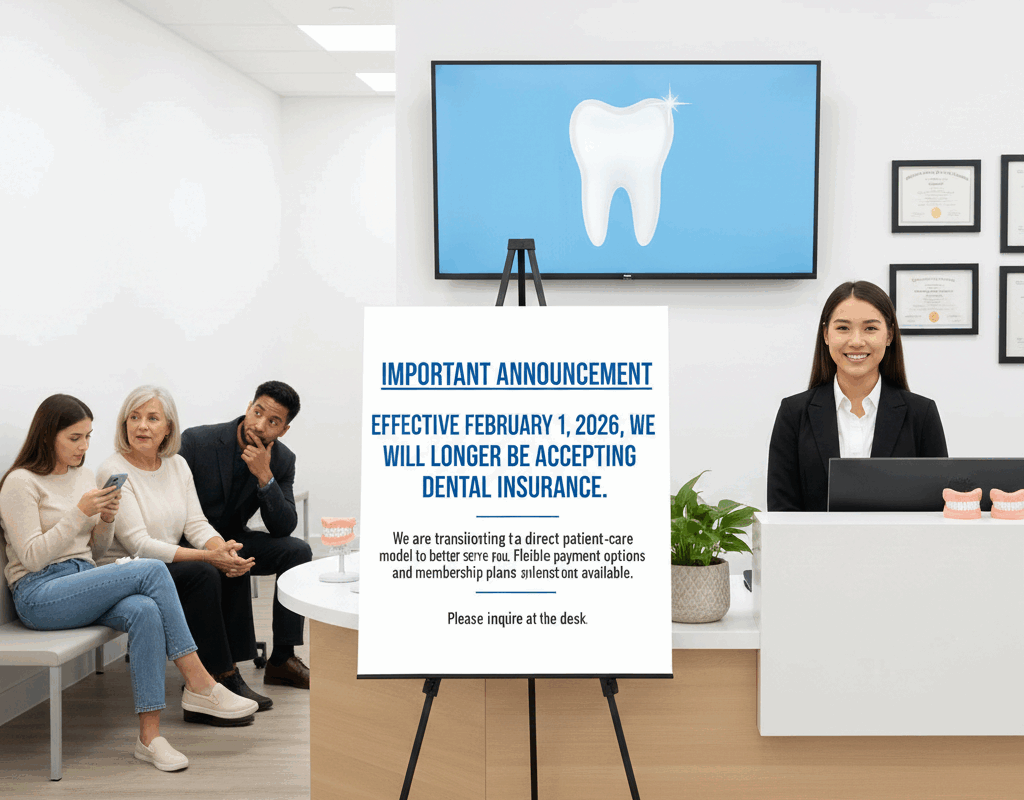
Dentists have been talking about it for years, but in the last few years it’s become a real movement. More and more practices are choosing to go entirely fee-for-service (FFS) or out-of-network (OON) with most (or all) dental insurance plans. For a lot of offices, it’s a gradual exit dropping one plan at a time. For others, it’s a clean break driven by economics, admin burden, and a desire to regain clinical and financial control.
The big takeaway: as more practices reduce insurance participation, patient affordability becomes the make-or-break factor for treatment acceptance. And that’s where offering a strong third-party financing option becomes less of a “nice-to-have” and more of a core part of the practice’s access-to-care strategy.
How prevalent is the shift to OON/FFS?
Reliable, recent data points to a meaningful and growing share of dentists reducing network participation:
- In 2025 29% of dentists dropped at least one insurance network according to the ADA’s “Economic Outlook and Emerging Issues in Dentistry”
- The same study in 2026 says that 35% of dentists plan to drop at least one insurance network this year.
- In 2025, Becker’s Dental reported ADA HPI third-quarter findings that 25.7% had already dropped insurers that year and 24.2% said they may drop later in 2025.
Even if the exact percentages vary by survey and timeframe, the direction is consistent: dropping networks is no longer a fringe strategy for dentists, it’s becoming a mainstream consideration.
Why are dentists leaving insurance networks?
The reasons aren’t mysterious. They’re both operational and financial.
ADA polling in 2024 shows the leading drivers clearly:
- Reimbursement amount: cited by virtually all dentists who dropped networks
- Administrative burden: claims, denials, pre-authorizations, paperwork, staff time
And beyond those headline reasons, many practices describe a broader theme: insurance increasingly dictates the economics of the appointment, while overhead (staffing, supplies, lab costs, rent, technology) continues to rise. Some dentists also want more autonomy in treatment planning and scheduling, less time “coding to get paid,” more time practicing dentistry.
In short: when reimbursements feel compressed and admin work expands, going OON/FFS can look like a path back to sustainability.
What changes for the patient when a practice goes OON or FFS?
This is the critical part and it’s where practices can either thrive or struggle.
When you’re in-network, insurance typically reduces the patient’s out-of-pocket cost at the time of service even if it creates complexity behind the scenes. When you go OON/FFS:
- Patients may need to pay more upfront and get reimbursed later (depending on plan rules)
- The “what will this cost me?” conversation becomes more direct and more frequent.
- Patients who love the practice may still hesitate, not because they don’t value the care, but because costs are substantial
Even patients with insurance can be surprised at how limited dental benefits often are. And many Americans have no dental coverage at all. One recent commentary highlighted that tens of millions lacked coverage in 2023 and that affordability remains a major barrier to care.
So as practices step away from networks, the question becomes: How do you maintain access and acceptance when more of the bill lands directly on the patient?
Why third-party financing becomes essential in OON/FFS practices
If you’re OON/FFS, your practice is essentially asking patients to do one of two things:
- pay out of pocket today, or
- figure a way to pay out of pocket over time
Third-party financing helps by turning a large, intimidating number into a manageable monthly payment without forcing the practice to become a lender.
1) Financing protects treatment acceptance
Dentistry is full of “I’ll do it later” procedures like crowns, implants, perio treatment, aligners, larger restorative plans. When cost becomes the primary friction point, patients delay. Financing reduces that delay by giving patients a clear path forward.
2) Financing supports case presentation without “selling”
FFS practices often emphasize premium care, time, experience, materials, and clinical autonomy. The moment a patient can’t afford the recommended plan, the conversation can shift from clinical value to price anxiety. Financing lets your team keep the tone clinical and supportive:
- “Here’s the ideal care plan.”
- “Here are payment options that can make it workable.”
That’s not selling. That’s access.
3) Financing helps retain patients during the transition
Many practices don’t lose patients because patients dislike the office. They lose patients because the new payment reality feels abrupt or confusing. Offering financing early and consistently helps soften the change:
- Patients feel like you’ve anticipated their needs
- You reduce sticker shock
- You preserve loyalty when insurance no longer “buffers” the cost
4) Financing can reduce front-desk strain
OON/FFS transitions can reduce the complications around insurance claims and reimbursement, but add new ones around downpayments, interest rates, and payment plans. A clear financing workflow, built into your consultation and checkout process, can reduce these new kinds of frictions.
Best practices: how to implement third-party financing in an OON/FFS model
A financing program works best when it’s simple, visible, and built into the patient journey:
- Mention financing availability early (website, new patient calls, treatment plan consult), not as a last-minute rescue after the patient says they can’t afford treatment.
- Train the team on language that feels helpful, not pushy: “Most patients choose monthly payments for plans of this size, do you want to see what that could look like?”
- Offer multiple paths for patients: pay-in-full, monthly payments, and (if you choose) a membership plan for preventive care.
- Use consistent visuals in consult rooms: marketing collateral and/or an interactive screen that shows example monthly payments for their specific treatment plan.
- Make the process fast so it doesn’t interrupt the patient experience.
The bottom line
Going OON/FFS can be a powerful strategy for practice sustainability, but it changes the economics for patients immediately. The practices that win in this model won’t just “drop insurance.” They will replace the lost affordability mechanism with something new: a modern payment experience that keeps care within reach.
As the data suggests, a growing share of dentists are reducing network participation. The next competitive edge won’t just be clinical excellence, it will be how confidently and compassionately your practice helps patients say “yes” to the care they need.
If you are new to Sunbit and would like a free demo of our award-winning patient financing solution, register here.
Know a dental practice that could benefit from Sunbit? Refer them here.